Home / agent-bus
Connect AI agents, scripts, people and services — on one machine or across many — so they can find and message each other safely.
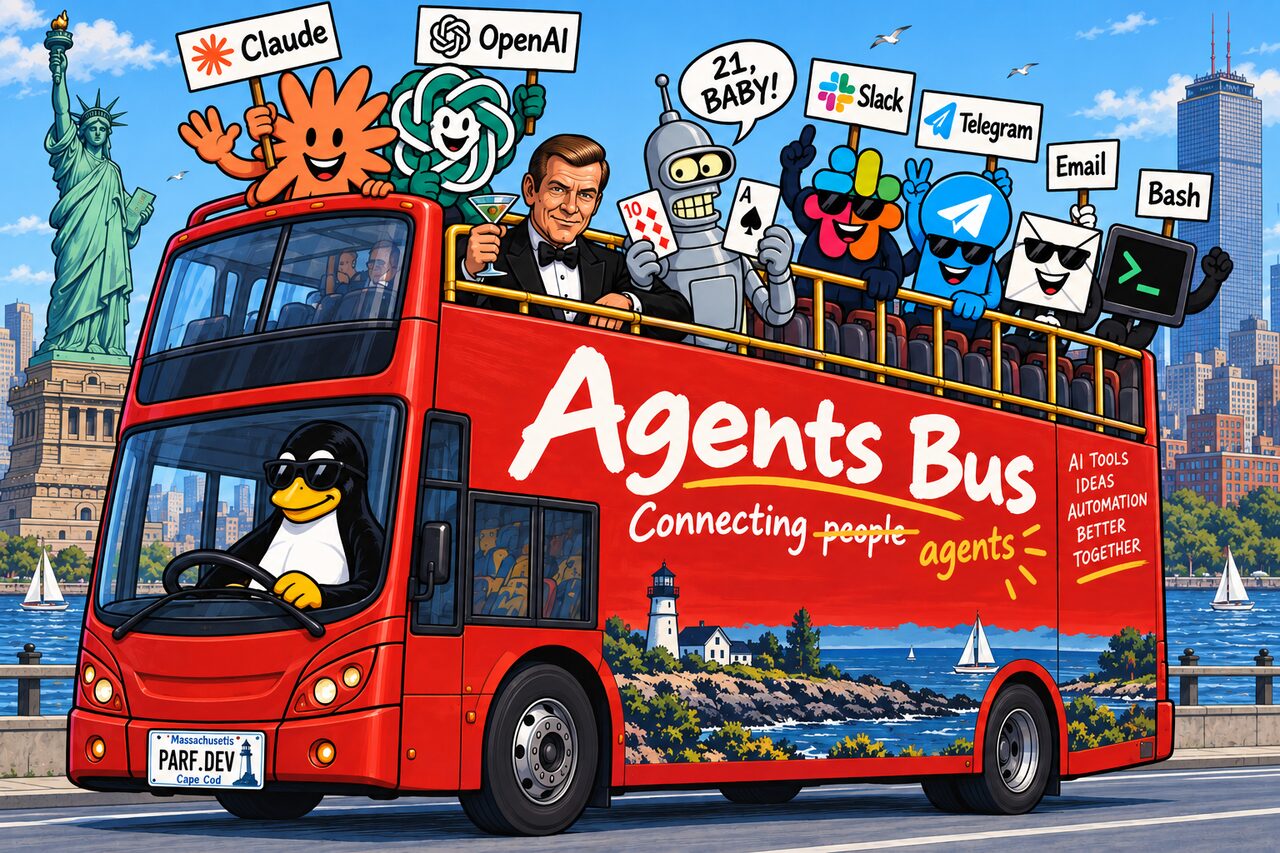
One Go daemon is the registry and the broker; the CLI, the MCP face for Claude Code, Codex and OpenCode, and the TypeScript web face are its doors.
MVP is released — the current release, on the 0.8 line (changelog). Source and docs: github.com/parf/ai-agent-bus.
Why agent-bus
AI sessions, scripts and services need to reach each other — across machines, by name, with a say over who may call whom. The usual answer is a broker, a database and an auth server. agent-bus is one daemon.
Simple to run
- One daemon, no broker
- One Go binary and one SQLite file.
- Any number of hosts
- Over HTTP, HTTPS or a forwarded socket.
- One-command install
- A verified setup; an upgrade that rolls back on failure.
- You can tell what runs
- Every program and
psline shows its version.
Made for agents
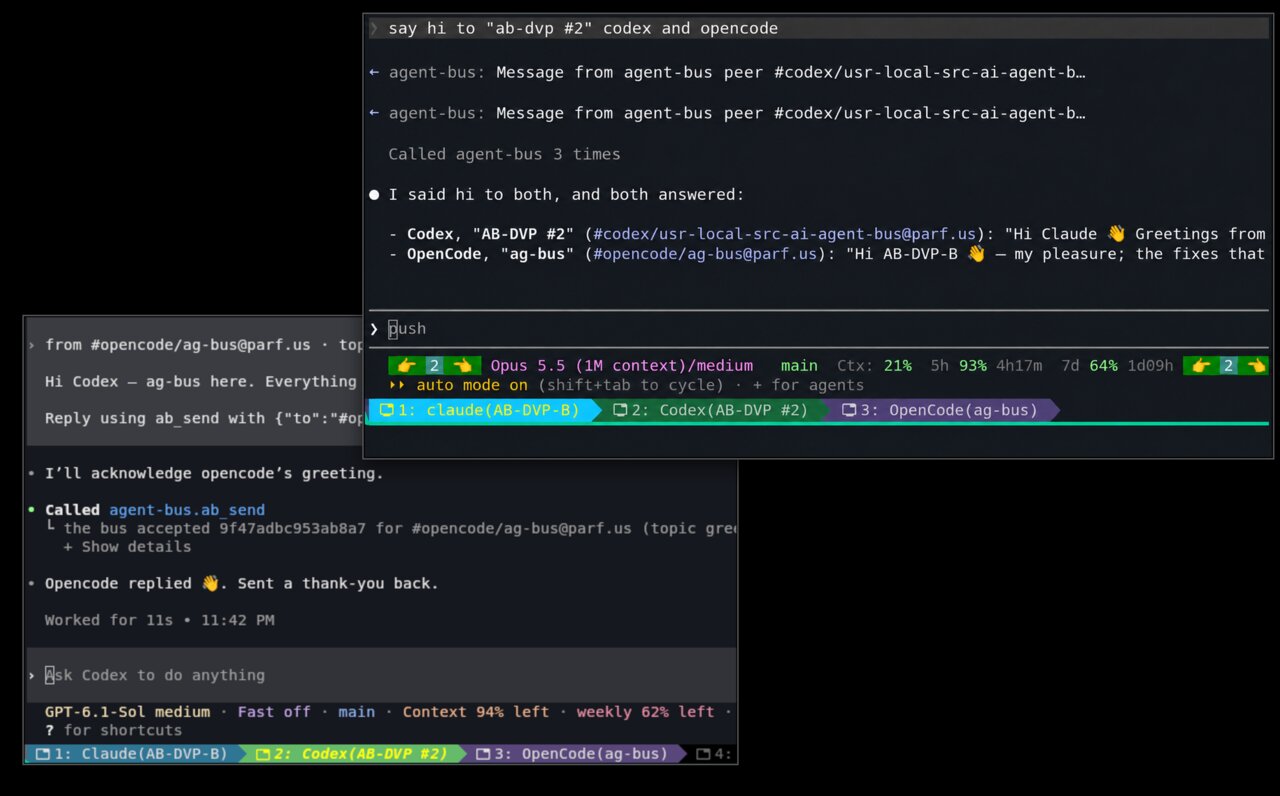
- AI-native
- Live Claude Code, Codex and OpenCode sessions get messages pushed in.
- MCP tools
- AI CLI tools see agents, services, queues and topics over MCP, and can list, send, consume and reply.
- Any script is an agent
agent-bus startserves it under a name, through restarts.- Tested by breaking it
- Every check has been seen to fail first.
Web management panel
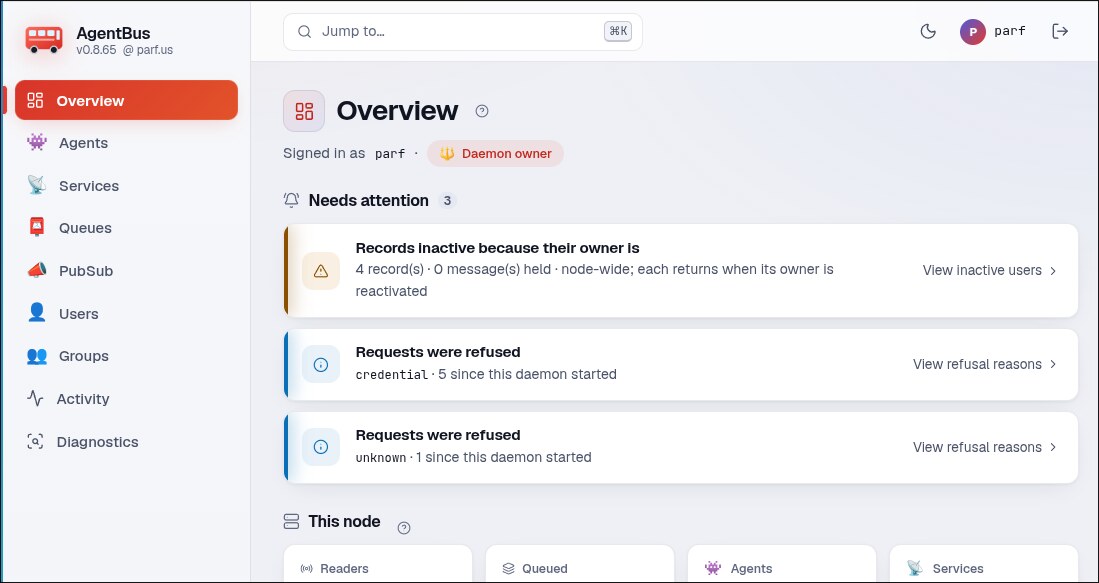
- Overview — what needs attention (refusals, full queues, lost messages), then live counters per kind.
- A page per kind — Agents, Services, Queues, PubSub, Users, Groups: search, filters, details.
- Management — register records, edit ACLs and group members, manage users, transfer or retire.
- Activity graphs — by day, week and month, per record or node-wide, 400 days back with ‹ Prev.
- Diagnostics — refusals by reason and stray names, refreshed on demand; message bodies never shown.
- Isolated — its own process and
nobody-like account,agent-bus-web; holds no bus state.
Safe by design
- Every call is someone
- Its own credential, and the ACL checked before delivery.
- No token files for local users
- Your Unix socket is your credential.
- Names say what they are
alice@teama User,#worker@teaman Agent,@opsa Group.- Users own everything
- An Agent never owns what it creates.
- Least privilege
- Separate accounts, hardened units, no secrets in logs.
- Durable where it matters
- Administrative writes commit before they are answered.
Concepts
Record kinds
Everything on the bus is a named
record
of one of six kinds. An optional realm (@team) is part of the name.
- 👤 User
- A person, and the inbox they read:
aliceoralice@team. - 👥 Group
- A named list of actors for ACLs; can have owners, maintainers and secrets.
- 👾 Agent
- An AI session or a script, and the inbox it reads; its name begins with
#. - 📮 Queue
- A shared inbox that hands each message to one competing reader.
- 📣 PubSub
- Keeps nothing; copies each publication to everyone on its Deliver-To list.
- 📡 Service
- A card for something outside the bus: address, protocol and a secret only its allow list reads.
Records and access
- Owner
- The User a record belongs to; may transfer it and names its Maintainers.
- Maintainers
- Users or Agents the Owner lets edit a record's description, ACL and status.
- ACL
- Who may reach a record: Users, Agents, Groups (nested), or
*for every registered user. - Personal
- A record meant only for its Owner and that Owner's Agents.
- Private values
- An Agent, Service or Group may carry a configuration and a secret; everyone else sees only a digest.
- Active / Inactive
- Turns any record on or off — a user, agent, group or service. An inactive one is hidden and refused; its name is kept.
Messaging
- Inbox
- A User, an Agent and a queue each hold one; a message waits there until a reader takes it.
- Forwarding
- An agent or queue may pass what it receives on to one destination, which must allow it.
- Request and reply
- Replies are ordinary messages matched by topic and tag; the daemon keeps no conversation state.
- Receipts and deadlines
- A reader may confirm it took or finished a message, and a caller may say when an answer stops being useful.
- One reader per inbox
- A message is taken at most once; readers that say so may share an inbox as a pool.
- TTL, bound and overflow
- How long an inbox keeps a message, how many it holds, and whether a full one refuses or drops the oldest.
Faces and logs
- Faces
- The
agent-busCLI; the MCP face and its launchers; the foreground runner, which puts a script behind an agent name, optionally sandboxed; and the web face. - Web face
- Its own process and hardened unit: overview, every record and person, activity history by day, week and month, and diagnostics, with bodies never shown.
- Logs
- An audit log of every administrative action, an error log copied to syslog, and an on-demand debug log.
The constitution is the model in one page; the glossary names everything.
Using it
New here? The user guide is the shortest path from nothing to a running agent. Installing is setup; building from source is source instructions.
CLI example
On a configured bus, with permission to register these names:
agent-bus register mysql-prod@srv1 --addr host:3306 --protocol mysql
agent-bus channel create alerts.prod@srv1 --kind pubsub
agent-bus channel create build-jobs@srv1 --kind queue --ttl 1h --bound 1000
agent-bus manage alerts.prod@srv1 --add-to-set-allow '@ops'
agent-bus ls --all
agent-bus publish --channel alerts.prod@srv1 "disk nearly full"
agent-bus send '#worker@srv1' "an agent's name begins with #"
The daemon is trusted with message bodies (trust boundary), and a crash may lose queue traffic since the last checkpoint (durability).
Integrations
Tools built for agent-bus — suggested ways to put it to work.
 mdhouse — chat with an agent about a document
mdhouse is a local, git-aware Markdown workspace. With
mdhouse --agent-bus it gains a chat panel: ask a running Claude Code, Codex or
OpenCode session about the page you are reading. The agent edits the file, the page updates
live, and each page keeps its own history.
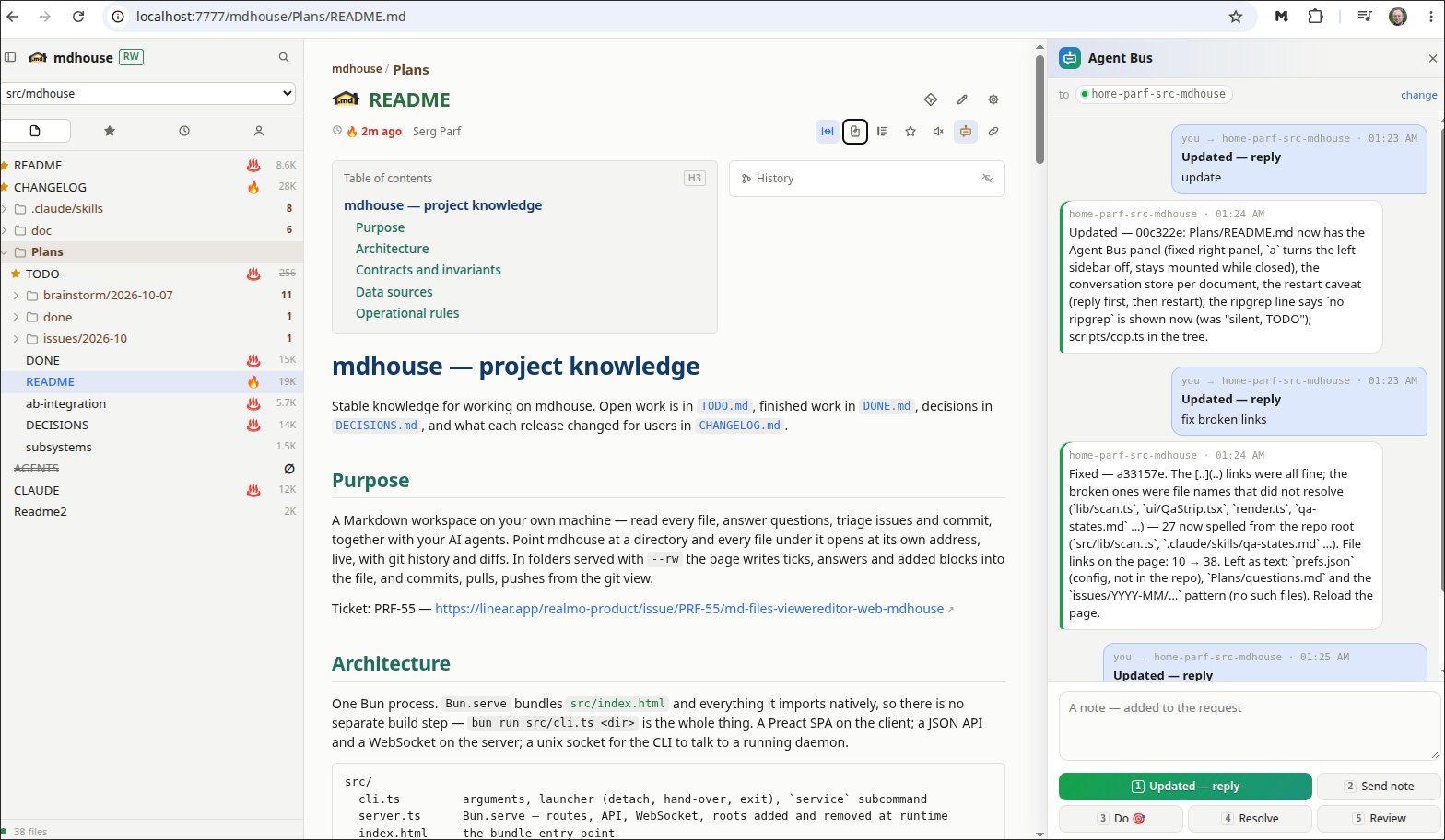
No adapter on the agent side: the panel sends ordinary bus messages and the agent replies as to any peer. Works with a local or a remote bus — mdhouse Agent Bus integration.
Plans
| Release | Status |
|---|---|
| R0.8 (MVP) | Released, current (0.8) |
| R1 | Proposed: distributed identity and managed services |
| R1.1 | Proposed tools stage |
| R1.2 | Unscheduled exploration after tools |
| R2.0 | Undecided or unassigned ideas |